Sharing Route 13
The main road down the spine of the peninsula is also a farm road, a truck route and a commuter road. At harvest, all three happen at once.
Route 13 runs the length of the Delmarva Peninsula, from Wilmington down through Dover and Salisbury to the Chesapeake Bay Bridge-Tunnel at the southern tip of Virginia's Eastern Shore. For long stretches it is a fast divided highway. It is also the road that farmers, grain haulers and poultry trucks use every day, because there is no other way to get from one end of the peninsula to the other.
That mix is the thing to understand. A car doing the speed limit can come over a rise and find a tractor doing twenty.
The farm traffic
Agriculture is the peninsula's oldest business, and poultry is by far its biggest part. Chicken houses stand in long rows behind the farmhouses, and the trucks that carry feed, birds and grain run on Route 13 and its side roads around the clock. In spring and fall the field equipment comes out too: planters, sprayers, combines and tractors pulling wide disc harrows from one field to the next.
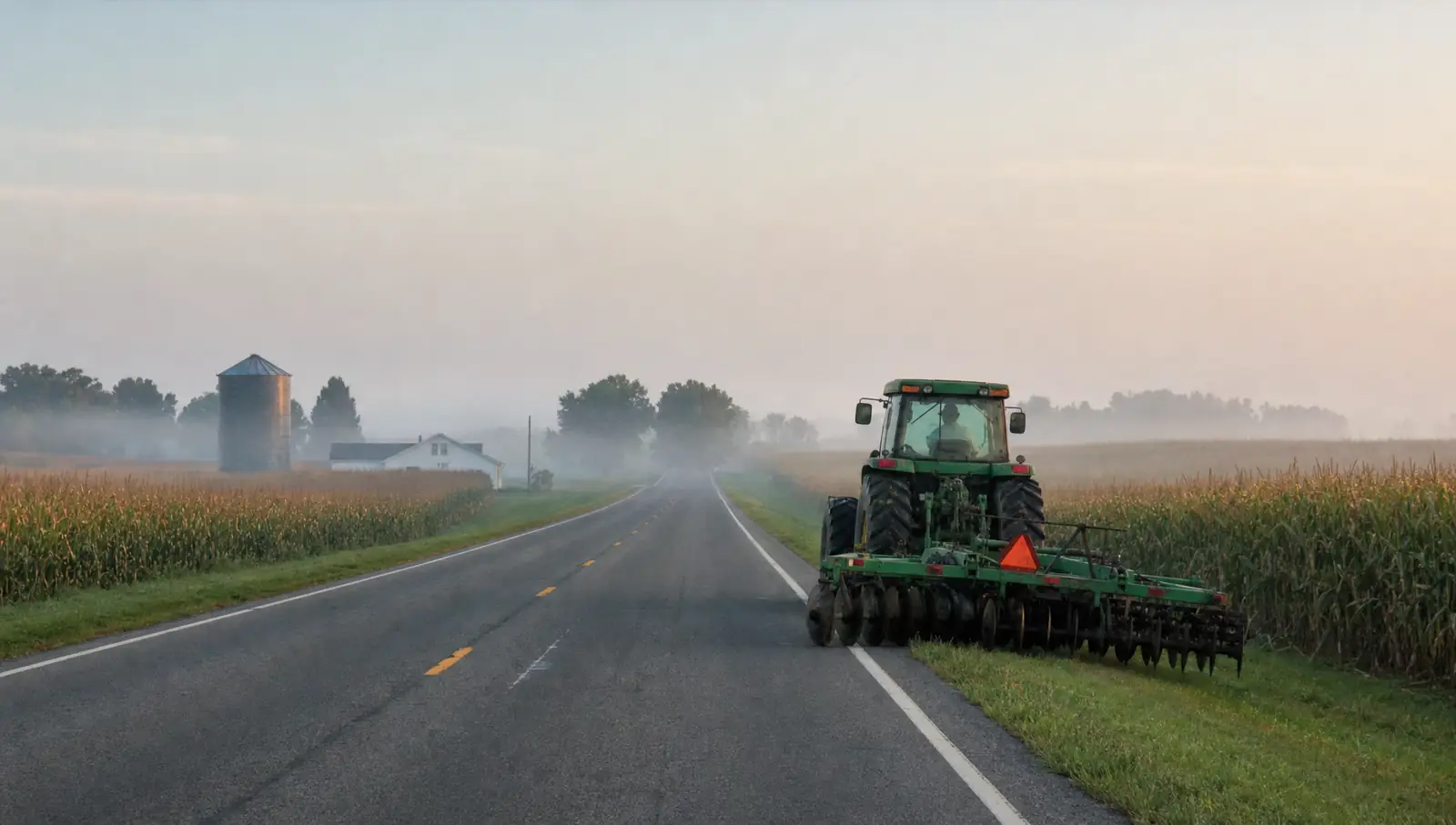
Farm equipment on the road carries a reflective orange triangle with a red border, the slow-moving vehicle emblem. It marks a machine built to travel at 25 miles an hour or less. Closing speed is the danger. At highway speed, the gap to a slow tractor disappears much faster than it seems to.
Passing with care
- Slow down as soon as you see the orange triangle, before you are close behind it.
- Pass only where the lines and the sight distance allow it. A tractor is wide and long, and passing it takes more road than a car.
- Watch for a left turn. Wide equipment often swings right first to make the turn into a field lane, which can look like an invitation to pass.
- Give the driver time. Many will pull onto a wide spot to let a line of cars by once it is safe.
Trucks and the morning rush
The big trucks keep their own hours. Grain trucks run heavy at harvest, and poultry trucks often move at night and in the early morning, sharing the road with commuters heading for Dover, Salisbury or the bridge. A loaded truck needs a long way to stop, and its driver cannot see a small car tucked close behind the trailer.
A shared road
None of this is going away. The fields and the chicken houses are why the towns along Route 13 exist, and the road was there for the farms long before it carried beach traffic. A few extra minutes behind a tractor on a fall morning is part of the price of driving through a working landscape.